
Socratic Retreat 2026: Studying Plato on the Vocation of the Teacher
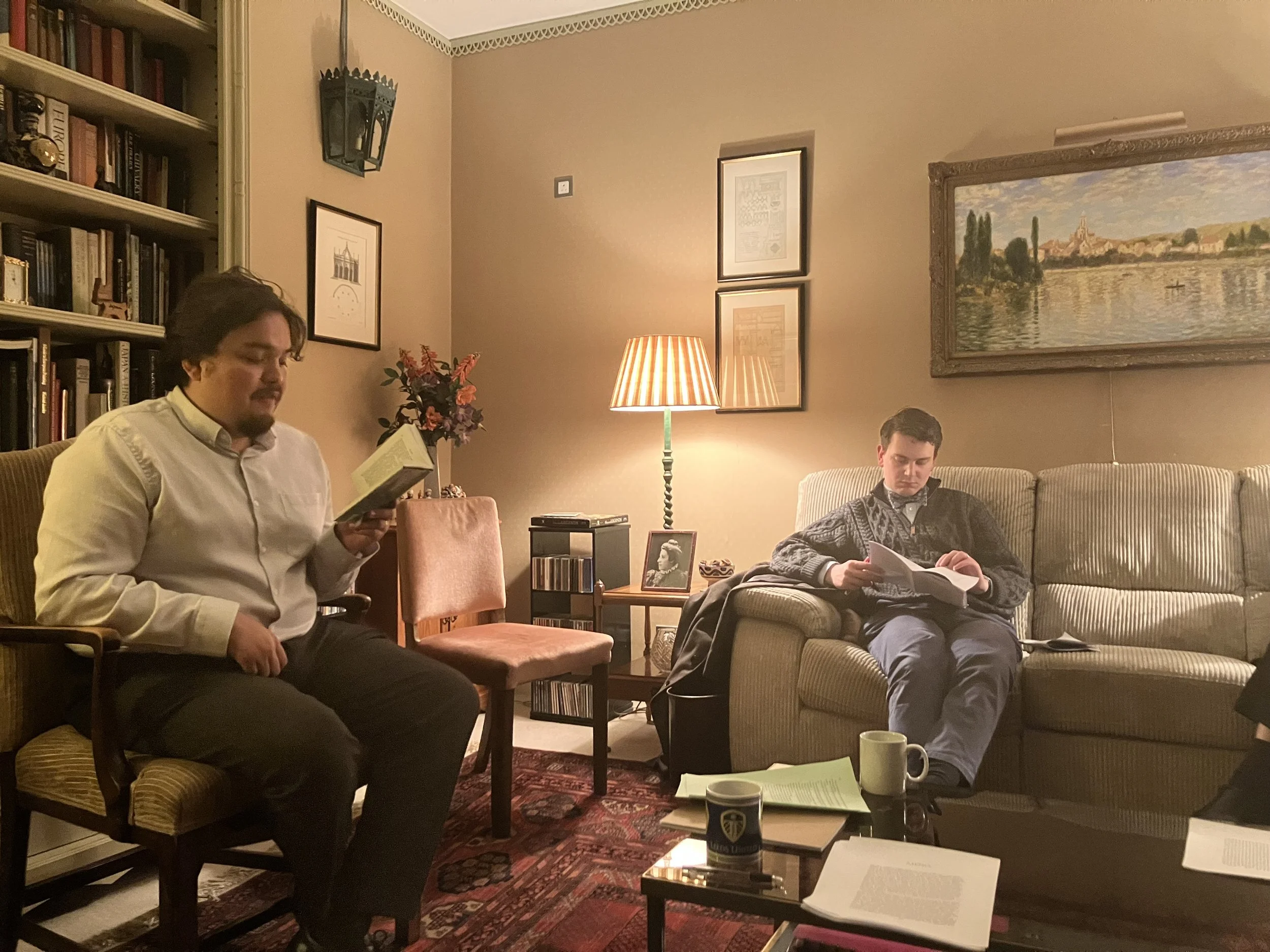
The opening seminar of the weekend was a discussion of the first half of Plato’s Meno, led by Francisco Contreras (left), Assistant to the Dean of the Pascal Institute, Leiden, Netherlands.
Led by Francisco Contreras from the Pascal Institute, Leiden, and Jack Thomson, Acting Director of the Ruskin Centre for the Humanities
The Ruskin Centre’s Socratic Retreat 2026 (8th-10th May)
Last weekend (8th-10th May 2026) the Ruskin Centre launched its first ever formation activity for teachers, led by Francisco Conteras Morán and Jack Thomson. Together, we hosted a retreat for teachers in the UK to experience the rich intellectual formation of the Pascal Institute.
Through an immersive programme of ‘great books’ seminars and pedagogical practices, our teachers came to understand the principles behind and values of socratic education. Studying together two of Plato’s most renowned dialogues, we reflected on the role of the teacher, the nature of philosophical insight, and true knowledge. We also got to experience the value of communal study and the effectiveness of the socratic method.
The Ruskin Centre intends to make the Socratic discussion the hallmark of its classes. We are grateful to Francisco for providing us with the opportunity to study this method in greater depth and to experience its transformative power. More formation opportunities to follow for our prospective course leaders.
Join our mailing list to hear about upcoming formation activities and to be the first to know about our first ‘great books’ courses for professionals.
What is the role of the teacher?
A socratic discussion of the first half of Plato’s Meno, a dialogue about whether it is possible to teach virtue. The dialogue raises questions of the nature of the student-teacher relationship, the difference between right opinion and true knowledge, and the method of teaching which is most conducive to occasioning insight, understanding, and knowledge in students.
We were struck by the paradoxes in the student-teacher relationship:
The problem of knowledge: Socrates, a teacher, claims to know nothing about the subject under investigation. This comes from a place of wisdom rather than total ignorance;
Questioning aș a method: that a teacher should proceed only by asking questions seems contrary to the common idea of a teacher who lectures at students;
Provocation: Meno and Socrates provoke one another with their questioning: does this work with or against the process of learning?
Destruction and reconstruction: Meno experiences Socrates questioning as destructive and gets frustrated, whereas Socrates sees a bigger purpose as he clears the way for real insight. How can we encourage our students to undergo that process of letting go of former ideas?
We ultimately had to confront the question of why Socrates should be a model teacher, given that he claims to lack knowledge and that he proceeds only by asking questions.
Meno exemplifies a student who lacks any synthetic knowledge. All he has are received ideas, which he has neither the experience nor the humility to scrutinise properly, and so he is surprised to see himself refuted by simple questioning. Socrates’ method of questioning exposes the need for a method of teaching which goes beyond the transmission of facts, and yet his method is very practical and powerful, as the participants themselves experienced. The spirit of inquiry establishes an enduring relationship to the truth, even if we are unable to finally exhaust the truth of things.
What is true knowledge?
The second discussion followed the second half of Plato’s Meno, centring on the question of the difference between right opinion and knowledge, given that there appears to be no functional difference between them. Knowledge, according to Socrates, involves the ability to give reasons, and for this reason it endures, whereas opinions tend to be forgotten.
We inquired into the possibility of certainty. They reflected on the dignity and importance of the search for truth, which consists in self-examination (not skepticism) and which characterises Socrates’ method, in contrast with those that are about winning, the transfer of facts that are taken for granted, or which serve simply as rhetorical exercises.
In the end, we concluded that, although both right opinions and knowledge enable you to perform a role adequately, only knowledge goes you adaptability within and across roles and subjects, enduring insight, an the possibility in principle of leading another towards insight.
An apology for wisdom
A socratic discussion of Plato’s Apology of Socrates. Whilst on trial, Socrates gives a bold defence of his pedagogical method, which for him is rooted in a vocational experience connected with the Oracle of Delphi. He presents himself as having insight into the vanity of trying to save one’s life through lying or betrayal of oneself.
The prompt for this discussion led on from the first pedagogical practice. We were asked to identify whether Socrates exemplified any of our definitions of courage. We considered that Socrates’ conduct was somewhere between courage and recklessness, because he intentionally provokes the court with his questions. Yet this is consistent with his vocation as a teacher, which is to test those who claim to have understanding and wisdom. In exposing the lies of the court, Socrates condemns himself to death.
At root is the question of caring for the soul over the world. None of the rulers or experts have what they profess to have, namely understanding and virtue. Socrates’ life becomes a testimony to the true path to truth, understanding, and virtue.
About the Pascal Institute
The Pascal Institute was founded by Jordi Wiersma. Pascal offers advanced, semester-length in-person courses in Leiden in which students are guided through the study of great books. It’s teachers employ the ‘socratic method’, which is question-led. They also prioritise the text, on the assumption that it contains something of formative value.
Pascal offers their teachers regular in-person formation in accordance with these aims. This includes a practice of meeting together to read in silence, before entering into a socratic discussion of what they have just read; inviting teachers to co-teach courses and even lead some seminars; and working together to distinguish different approaches to teaching according to the kind of book being read.
Pascal equips teachers with diverse teaching methods appropriate to different kinds of texts and levels of students, though united by an essentially socratic character, and helps them to build meaningful pedagogical relationships with their students and with each other.